The 2026 Fall Newsletter is available below. 2026 Fall Dinner Meeting tickets are now on sale today through September 8, 2026 (or when sold out, only 80 available).
Fall Meeting Schedule of Events
1:00 PM: Executive Sessions 4:00 PM: Social Hour & Merchandise Sales 5:00 PM: Dinner 6:00 PM: Fall Business Meeting & President’s Awards Ceremony 7:00 PM: Guest Speaker: Bethany Adams, Author of Unsupported
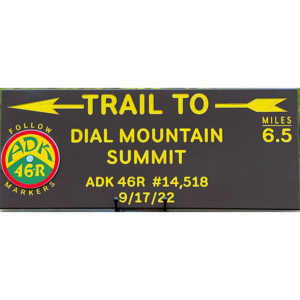
Custom ADK Trail Sign – One time offering only!! Customize your finishing date, mountain and 46er #! $120 includes US shipping. External product made by Rooted In Upstate.
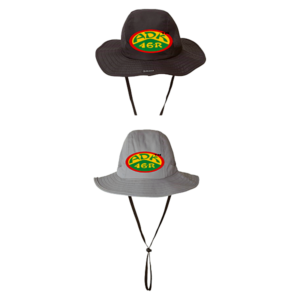
100% polyester, mini-ripstop fabric Quick dry performance UPF 50+ protection Laser cut ventilation pattern on both sides Adjustable, detachable toggle draw cord NO Sweat Moisture-management sweatband Foam in brim allows it to be floatable and packable Black or Gray
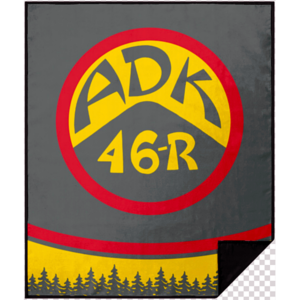
Perfect for ground blanket or at the beach Smooth soft front Water resistant back, black polyester 50 x 60 water resistance Comes with elastic carrying handle Full front print
All sales will be taken online at the website merchandise store – you must be logged in and have an active, paid member account to see the merchandise.
PLEASE PLACE SPECIAL ORDER ITEMS SEPARATELY. DO NOT INCLUDE OTHER ITEMS ON THE ORDER FORM!
Distribution will not start until the sales ends, and vendor starts production. DEADLINE to Order is: September 18, 2026.
PLEASE DO NOT EXPECT delivery of merchandise until the week of October 19, 2026.
Questions regarding special merchandise can be sent to merchandise@adk46er.org. All proceeds go to supporting our education, stewardship and volunteer projects. Thank you for your support.
THE NEW EMAIL ADDRESS IS TRAILHEADSTEWARDS@ADK46ER.ORG
Saturday, April 18th, and Sunday, April 26th, and Saturday, May 16th, and Sunday, June 14th
You only need to attend one session, but all stewards must attend one session in 2026
Conference Room NYSDEC Offices 1115-NY86 Raybrook, NY
8:00 am: Gather, complete paperwork, distribute uniform shirts*, Introductions, About TSP, discussion of feedback from previous season
9:00 am: NYSDEC Forester/Land Manager, Tate Connor Why we are here / Q&A
10:00 am: NYS DEC Forest Ranger if available/Common regulations/errors/Q&A
11:00 am: LNT/hikeSafe – Consistency of messaging is important
12:00 pm: Lunch on your own – note limited time you may wish to bring lunch
12:30 pm: LNT/hikeSafe – Consistency of messaging is important
1:30pm: Authority of the Resource/Interacting with public/Q&A/
2:00 pm: Your responsibilities/review of the handbook and site locations/Demos
3:00 pm: Supporting and recognizing your work, service award hrs, fb page/Q&A
4:00 pm: Dismissal
*If you have a shirt you would like to return for a different size, please bring it with you. Please complete the required on line Sexual Harassment training and read and sign the Code of Conduct prior to this class. Have your 46er number with you!
By providing hikers with information prior to hitting the trail, you are providing them with an experience that will be successful, fun, safe, and protects the lands and mountains they are enjoying. Thank you for participating in the Adirondack 46ers Trailhead Steward Program.
NOTE: This is the final installment of the four-part series that explores the people for whom the mountains in the Dix Range were named.
“Names are powerful things. They act as an identity marker and a kind of map, locating you in time and geography. More than that, they can be a compass.” — Nicola Yoon, author, from The Sun is Also a Star
All of us who climb the 46 Adirondack High Peaks develop an inherent familiarity with the mountains and their trails. We have our favorite summits. We know the trails, where the steep sections are, and when we are approaching the areas that are always muddy. We have our own special places to stop for a break, or to enjoy a view. We can almost feel the mountains’ moods on any given day, whether they will be kind to us as we climb them or throw every possible obstacle in our way. We feel a kinship with the peaks as we get to know them. If we climb peaks enough times, we even consider them our friends. We become so familiar with the mountains that their names roll off our tongues without giving it much thought.
But what do we know about those names? When did each peak receive its name? Who chose the name? Why? And for those mountains that are named for a person, who is he, or she, and what did they do to deserve to have a mountain named for them? Do the names of the High Peaks matter?
These questions surfaced on a recent hike in the Dix Range, where four of the five peaks are named for people. The search for answers led to a fascinating bushwhack through not only Adirondack history but U.S. history as well.
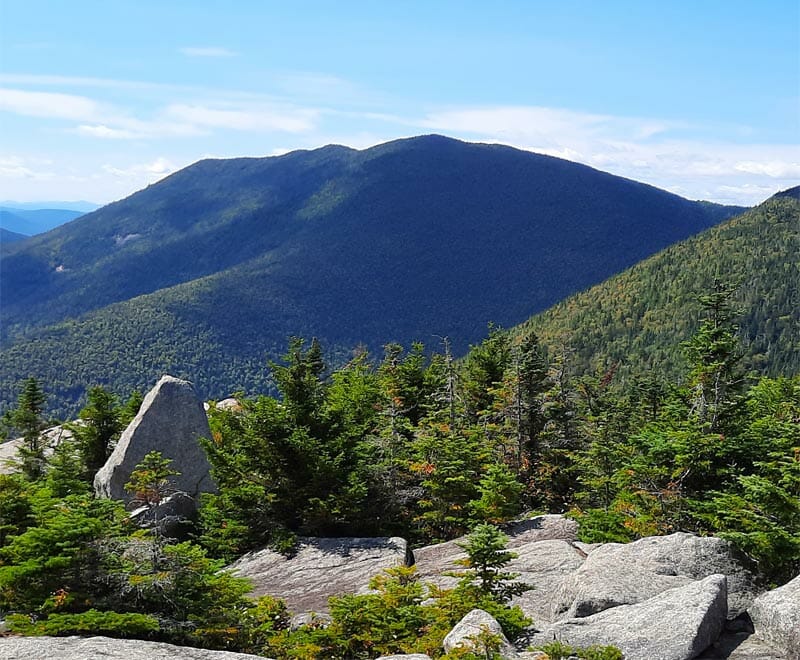
The long ridge of the Dix Range from Round Mountain
Grace Peak and South Dix
Grace Peak
All of the High Peaks received their names from a variety of people and circumstances throughout the 1800s and early 1900s, save for one. The peak previously known as East Dix, the smallest of the mountains in the Dix Range at 4,012 feet, underwent the most recent name change when it was officially renamed Grace Peak on June 14, 2014. The United States Board of Geographic Names approved the Adirondack Forty-Sixers’ petition to rename East Dix in honor of Grace Leach Hudowalski, the first woman to climb the 46 High Peaks and a founding member, first president, and long-time historian of the club.
Grace Peak from the Beckhorn on Dix
While Grace’s importance to the Forty-Sixers organization and to the Adirondacks should be familiar to fellow 46ers, her legacy deserves repeating. At the age of 16, Grace climbed Mount Marcy in August 1922. It was a defining moment in her life. Suffering through heavy rain and torturous black flies on the three-day hike, she refused to quit. When she finally reached the summit, the clouds lifted for a moment revealing Lake Tear of the Clouds—the source of the Hudson River—a mile below. From that point on she recalled, “I never talked about anything but mountains. I wrote about them. I gave speeches about them.”
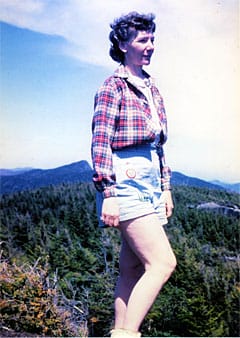
Grace Hudowalski wearing her typical hiking garb
Grace became the first woman and ninth person to climb all 46 of the Adirondack High Peaks when she summited Mount Esther on August 26, 1937. It was fitting that Grace finished her round of the 46 on Esther Mountain as, at the time, it was the only High Peak named for a woman — Esther McComb, the 15-year-old girl who was credited with the first ascent of the peak in 1839.
Grace was instrumental in the formation of the Adirondack Forty-Sixers (46ers) in 1948 and became the club’s first president. For more than 60 years she served as the club’s historian, corresponding with and mentoring thousands of hikers who were aspiring to become 46ers. Grace considered climbing the 46 to be a life-affirming and often life-altering accomplishment that deserved introspection. Her love and respect for the mountains and her belief that spending time in the natural environment was vital to a healthy, balanced life was undeniable. She encouraged hikers to write about what they saw and felt as they climbed and to share their experience with others. “Any mountain worth climbing is worth talking about,” was one of her favorite sayings.
Grace promoting New York State tourism at a Commerce Department event
Grace was a pioneer. She engaged in a rigorous outdoor avocation in which relatively few women participated, and she encouraged women “…to get out of doors, to get lots of fresh air to bring color to your cheeks and zest in your step. It’s more outdoor exercise we women need.” She also had a high-ranking professional position, a rarity for a woman at the time, as Travel Promotion Supervisor for the New York State Commerce Department. This job, which she held from 1948 to 1961, provided her with a platform to publicize the recreational opportunities in the Adirondack Region to a large audience.
Active in the early days of the Adirondack Mountain Club (ADK), Grace served as contributing editor for the club’s publication Ad-i-ron-dac, (now Adirondac). At its annual banquet on March 13, 2004, the ADK conferred on Grace its highest honor, the Trail Blazer Award (in absentia as Grace passed away that same day at the age of 98). To honor her lifelong dedication to the Adirondacks, the 46ers, led by Doug Arnold, #4693W, embarked on a ten-year–eventually successful–effort to name an Adirondack High Peak in her honor.
South Dix
The view from the summit of Grace Peak of Macomb and South Dix
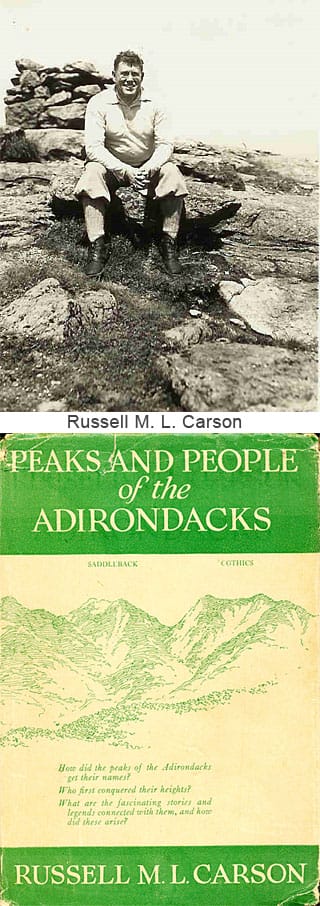
At an elevation of 4,060 feet, South Dix is now the only peak in the Dix Range that does not have a distinctive name. It remains identified only by its position in comparison to the other four peaks. In his book Peaks and People of the Adirondacks, Russell Carson credits the naming of both South and East Dix to the Marshalls. Prior to the Marshalls’ climbs of the 46 High Peaks the two peaks were not identified on any maps. Carson said, “The most interesting fact about these two mountains is that their names are not important enough to be retained and that they can be given distinctive titles, when the right occasion comes, without violation of old-established names.” The “right occasion” came along for the renaming of East Dix to Grace Peak in honor of Grace Hudowalski. Perhaps a deserving occasion will come along for the renaming of South Dix. One suggestion is to rename South Dix “Carson Peak,” in honor of the author of the definitive book on the history of the peaks and people in the Adirondack High Peaks Region.
Names remind us of the past, how the United States came together as a nation and the people who changed the course of history. Proof positive that as Nicola Yoon’s quote reminds us, “Names are powerful things, … locating you in time and geography,” and, like a compass, pointing us toward a future.
References: Carson, Russell, M. L. Peaks and People of the Adirondacks. The Adirondack Mountain Club, Glens Falls, NY 1986. The Conservationist. New York State Department of Environmental Conservation. May-June, 1985. Heaven Up-h’isted-ness! The History of the Adirondack Forty-Sixers and the High Peaks of the Adirondacks. Adirondack Forty-Sixers, Inc. 2011.
— SEL, 2023
Hough Peak from Dix Beckhorn
Hough [Cone, Middle Dix, Marshall]
If the mountain Hough was human, it might be suffering from an identity crisis as it has undergone several name changes over the years. In the 1870s Verplanck Colvin, Superintendent of the Adirondack and State Land Surveys, identified the mountain now known as Hough as “Cone Mountain” on several of his sketches. In the early 1920s, Robert and George Marshall and Herb Clark, the first 46ers, referred to it as “Middle Dix” or “Little Dix.” Russell Carson, author of the 1927 Peaks and People of the Adirondacks, a comprehensive history of the naming and first ascents of each of the High Peaks, named the mountain “Marshall,” in honor of Robert and George Marshall, who “made the first recorded ascent of this peak, …” on August 13, 1921.
Although the Marshalls objected to having a peak named for them, the Forty-Sixers of Troy, the precursor of today’s club, embraced the name. In 1940, a year after the death of Robert Marshall, the Forty-Sixers of Troy petitioned the New York State Board on Geographic Names for official recognition of the names of several High Peaks including the mountain in the Dix Range that they called Mount Marshall. However, the Troy club was informed that the mountain they knew as Marshall had been officially named Hough Peak on both the state and federal levels, in honor of Dr. Franklin B. Hough. Though not widely publicized, New York State Conservation Department Commissioner Lithgow Osborne had submitted the name change request in 1937 at the time of the Fifty Years of Conservation Celebration.1 So, who was Hough? And should our peak be happy with its final, official appellation?
Franklin B. Hough, The Father of American Forestry
Dr. Franklin Benjamin Hough (1822-1885), the son of a doctor, was born in Martinsburg (Lewis County, on the western edge of the Adirondacks), New York. As a child he enjoyed taking long walks through the Adirondack forests studying and recording the flora and geology of the area. He graduated from Union College and studied medicine at Western Reserve Medical College. Like his father he became a medical doctor and set up a practice in New York’s St. Lawrence County. He eventually abandoned medicine to concentrate on research in natural history and writing projects. He returned to medicine for a few years during the Civil War when he was called to serve as a surgeon for the 97th New York Volunteer Infantry.
Following the Civil War Hough returned to his research on the natural environment. As one of seven members of the 1872 New York State commission on establishing a state park in the Adirondacks, Hough studied the alarming deforestation in northern New York due to uncontrolled lumbering. He wrote and presented a paper “On the Duty of Governments in the Preservation of Forests” that summarized his findings and highlighted the need to adopt forest conservation practices. He also advocated for the establishment of forestry schools that would develop guidelines and offer training on protecting, preserving, and managing woodlands. As a result of his research, along with several years of lobbying efforts, the United States Congress created the Office of Special Agent in the U.S. Department of Agriculture in 1876 to assess the state of the forests and the lumber industry. Hough was chosen to head the office. He conducted additional surveys and research throughout the United States the following year and presented his recommendations in his Report on Forestry, a 650-page volume that was printed in 1878.
The view of Dix from the summit of Hough
In 1881, the Division of Forestry, the precursor to the United States Forestry Service, was created within the Department of Agriculture. Hough was appointed as its first chief. He served in that position until 1883, when he was replaced due to unresolvable differences with the Commissioner of Agriculture. But he continued his research and writing, particularly on the management of public forest lands. In 1884 he became involved in a renewed effort to establish a forest preserve in New York State and played a major role in the passage in May 1885 of the law that created Forest Preserves in the Adirondacks and Catskills. The now famous mandate remains in the legislation today: “The lands now or hereafter constituting the forest preserve shall be forever kept as wild forest lands….”2 Hough died one month later at his home in Lowville, NY, shortly before his 63rd birthday. For his leadership in promoting the management and protection of public forest land Hough earned the title “The Father of American Forestry.”
Undoubtably Hough Peak is pleased to carry the moniker of the man whose vision and tenacity led to the establishment of the Adirondack Forest Preserve.
Eventually the Forty-Sixers were successful in securing a peak named in honor of Robert Marshall – the western most peak in the MacIntrye Range, which they referred to as Herbert. That effort took 40 years to complete — a story for another day.
The 1885 law that created the Adirondack and Catskill Forest Preserves was subsequently approved as an amendment to New York State’s Constitution in 1894.
Macomb, the second highest peak in the Dix Range at 4,405 feet, was named in the mid-1800s for Brigadier General Alexander Macomb to honor his victory over the British at Plattsburgh, NY, on September 11, 1814, during a crucial battle in the War of 1812. The name first appeared in Ebenezer Emmons’ Natural History of New York in 1842. However, definitive details on who suggested the name and when have been lost to history. There are two theories, but the one that has been accepted as most likely is that the peak was named as a tribute to Brigadier General Macomb’s military success.
Brigadier General Alexander Macomb “The Hero of Plattsburgh”
Macomb was born in Detroit in 1782, when the city was controlled by the British. His family moved to New York City where his father, also with the first name of Alexander, gained prominence as a land speculator. In 1798, at the age of 16, Macomb joined a New York militia company. He received numerous commissions throughout the next 12 years, rising to the rank of brigadier general in command of the land forces in northern New York during the War of 1812.
During September 1814 the British planned a two-pronged attack at Plattsburgh: on land along Lake Champlain’s shore, and a naval assault on the lake. General Macomb was tasked with defending the frontier of northern New York on land. Lieutenant Thomas Macdonough commanded the 14-ship American naval fleet on Lake Champlain.
A British force of 8,000 to 10,000 men under the command of Lieutenant General Sir George Prevost greatly outnumbered Macomb’s forces of 1,500 regulars and roughly 2,500 militia. Macomb developed a strategy to delay the advance of the British ground troops for as long as possible. His men cut down trees to hide roads, changed road signs, and set forests and buildings ablaze near the British encampments. On the day of the battle Macomb’s troops launched a series of skirmishes with the British, harassing the enemy without engaging in a full attack.
From The Pictorial Field-Book of the War of 1812, Benson J. Lossing
While the land battle was underway, a fierce naval battle commenced between Captain Macdonough and the British ships under the command of Captain George Downie. Downie sailed his ships directly at the American fleet. With long-range guns the British had the Americans at their mercy. As luck, or fate, would have it, the wind on Lake Champlain that day suddenly died down, disrupting the British ships’ formation. This gave Macdonough time to maneuver his squadron to an advantageous position to inflict heavy damage on the British ships. During the cannon fire Captain Downie, aboard the British flagship HMS Confiance was killed. Shortly thereafter the British fleet surrendered.
When informed of the fate of the naval battle, British land commander Prevost called off his attack and withdrew his army, knowing that without naval support his land troops would not be able to advance beyond Plattsburgh. The combined land and naval American victories proved to be a turning point in the War of 1812. The victory greatly influenced the terms of peace drawn up at the Treaty of Ghent, thus ending the war.
While today historians generally credit the victory at Plattsburgh to Macdonough’s defeat of the British fleet on Lake Champlain, at the time the American press gave the title “The Hero of Plattsburgh” to Macomb. He was promoted to major general for his heroism and received both the Thanks of Congress and a Congressional Gold Medal. He was promoted to commanding general of the United States Army serving in that position from May 29, 1828, until his death on June 25, 1841.
The obverse side of Macomb’s Congressional Gold Medal
The reverse side of Macomb’s Congressional Gold Medal
In addition to having a mountain named in his honor, a street in Plattsburgh and one of the dormitories on the Plattsburgh State College campus bear his name, as did the World War II Liberty ship SS Alexander Macomb.
The second story about the naming of Macomb Mountain, which has since been refuted, suggests that the mountain was named by a lumberman for General Macomb’s father. A wealthy merchant, fur trader, and land speculator, Macomb, Sr. became the largest landowner in New York State with the 1791 purchase of 3,600,000 acres in northern New York for a price of 12 cents an acre. Known as Macomb’s Purchase, the area included all the lands that now make up Lewis, Jefferson, and St. Lawrence counties, as well as portions of Franklin, Herkimer, and Oswego counties.
At 4,857 feet, Dix Mountain is the highest peak in the range that bears the same name. Professor Ebenezer Emmons, the state geologist of New York who headed the geological survey of northern New York in 1837, named the mountain “Dix’s Peak” in honor of John Adams Dix. The name first appeared in Emmons’ 1838 report of the survey expedition. At that time, Dix was serving as Secretary of State in the administration of New York State Governor William Learned Marcy, whose name Emmons attached to New York’s highest peak on the first recorded climb to its summit on August 5, 1837. It’s easy to speculate why Emmons chose those two names for the two peaks: Dix recommended the survey of northern New York to Governor Marcy, and Marcy funded the project and chose Emmons as its head. Despite their interest in surveying northern New York, it is unlikely that either Dix or Marcy visited the Adirondacks.
On various iterations of maps over the years the name Dix’s Peak was changed to Dix Mt., or Dix Mtn. Today’s hikers just refer to the mountain as Dix.
John Adams Dix (1798 – 1879), born in New Hampshire, had a long and distinguished career in the military and as a public servant. He served as an ensign in the Canadian frontier campaign during the War of 1812, and as a major general during the Civil War. In state government he was New York State Adjutant General, Secretary of State, and State Superintendent of Schools. In 1872, at the age of 74, he was elected the 27th governor of New York serving from 1873 through 1874. On the national level Dix served in the United States House of Representatives and Senate, as Secretary of the Treasury under President James Buchanan, and as U.S. Minister to France. Dix was a staunch abolitionist and was credited with preventing Maryland from seceding from the Union prior to the Civil War. In addition to his public service he was the first president of the Union Pacific Railroad in the 1860s during the construction of the First Transcontinental Railroad.
Dix’s Peak was first climbed in 1807, thirty years before it was given a name, by a surveyor named Rykert (first name unknown), who ran the north line of Township 49, Totten and Crossfield Purchase1, making it the second major peak in the Adirondacks to have a verifiable first ascent. The first of the 46 High Peaks to be climbed was Giant of the Valley by Charles Broadhead and his survey party on June 2, 1797.
In 1771, prior to the Revolutionary War, Joseph Totten and Stephen Crossfield, on behalf of several other investors including Ebenezer and Edward Jessup, petitioned the royal governor of New York for the right to obtain title for England’s King George III, a tract of land encompassing about one million acres in the south-central Adirondacks. The land was purchased from the Native American tribes who hunted in the area. Following the Revolutionary War, all lands held by the British Crown became property of the individual states that made up the newly formed United States of American. A number of land surveys were conducted prior to and after the war to define the boundaries of the tract, and several lawsuits ensued to determine the actual owners of specifics tracts.
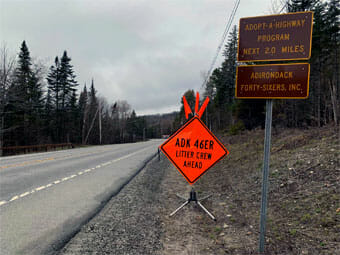
Lady ADK46er bagging trash along the highway – Adopt a Highway.
The 46er Adopt-a-Highway program has agreed to adopt another 2 mile stretch along Route 73. This adopted section covers from the turnoff of Route 9N, going past the Marcy Airfield, and leading into the town of Keene Valley.
This year the program will also try out a new schedule for cleanup events. Several volunteers come from out of the area and stay locally, so we will be doing back to back days. This will give those who desire a chance to do multiple days of volunteering with less driving. The new schedule will take a July/August break to avoid the busiest and hottest time of year, but also eliminate April and November cleanups when snow is a strong possibility.
This year we have reserved lean-tos at the Adirondack Loj for up to 10 volunteers on the night before the first day of cleanups available on the nights of; May 19th and 20th, June 7th and 8th, September 27th and 28th, and October 6th and 7th. Preference will be given to those who are signing up for both dates on a first-come, first-serve basis until we reach capacity. Please let Lee know if you wish to use one of these lean-tos when you sign up.
Meanwhile, we want to say thank you to all of our volunteers for giving back and making this program a success!
Keeping safety in mind, the Adirondack 46ers have purchased 2 reflective safety highway signs, one for each end of the adopted section we are working on. These signs will help keep us all safer to help alert oncoming drivers that a litter crew is ahead. Hard hats, safety vests, orange garbage bags and litter grabber tools are all supplied.
We will have a supply of nitrile examination gloves; however most people decide to bring their own work gloves. Another safety related item: you are required to wear long pants, no shorts. We would really hate to have to inform a volunteer that they could not participate because they showed up wearing shorts. Also, while the NYSDOT recommends leather shoes or boots rather than sneakers, please make sure that whatever footwear you have is closed toe with your heel covered.
Sexual Harassment Training & Policy
Please take note that in 2020, the 46er Executive Board of Directors adopted a new Code of Conduct and Sexual Harassment policy. ALL volunteers will now be required to take the approved sexual harassment online training AND sign the 46er Code of Conduct and Sexual Harassment policy annually*** PRIOR to participating in any volunteer activities.
If you are considering volunteering, please allow yourself enough time to complete the training, which takes approximately 45-50 minutes, so that information can be submitted and entered into our database for reference at each event. Training certificates and signed policies will not be accepted by leaders at events. The Executive Board approved that you will earn 1 hour toward your Volunteer Service Award (VSA) for completing the online training once both your certificate of training completion and signed policy is submitted. Screenshots of training certificates AND signed policies must be sent to Volunteer Coordinators AND emailed directly to our database coordinator at shtraining@adk46er.org.
The link to the approved online training and policy can be found here: https://adk46er.org/code-of-conduct-policy/. We have adopted this policy to protect not only our wonderful and dedicated volunteers, but also the organization that we love. We appreciate your efforts to give back to the mountains.
Our Adopt-a-Highway mission is to leave the sides of the road looking beautiful! Will you lend us a hand?
This image of David Henderson is from an oil portrait painted by Charles C. Ingham, an accomplished and well-known portrait artist during the early to mid-1800s.
If you have hiked the Calamity Brook trail into the Flowed Lands, chances are you have stopped at the stone monument at Calamity Pond that marks the spot where David Henderson met his calamitous death. For many hikers the large stone marker is a cause for celebration as it means that after walking 4.3 miles from the Upper Works trailhead there is just another 0.4 miles remaining to reach the Flowed Lands. But the inscription on the monument commemorates a sad and tragic death: “This monument erected by filial affection, to the memory of our dear father, David Henderson who accidentally lost his life on this spot. 3rd September 1845.” Aside from memorializing the death, the dedication gives no information on Henderson himself—who he was, his place in Adirondack history, or his impact on the development of the iron works at Upper Works, the remains of which can still be seen on the road leading to the Calamity Brook trailhead.
An interpretive sign just before the trailhead register at Upper Works provides some basic information on Henderson and his connection to the area.* Born in Scotland in 1807, he came to the United States as a young man. He was a savvy businessman and became a partner in a pottery manufacturing company in New Jersey. In 1829 Henderson introduced in America the British method of making earthenware from molds instead of on the potter’s wheel. A born leader and a visionary, he was also a multi-talented visual artist, violin player, and writer.
This interpretive sign adjacent to the Upper Works trailhead register provides a glimpse into the life of David Henderson and his involvement with the iron works. It is one of several panels developed by the Open Space Institute that describe the history of the iron works and the village of Adirondac.
Henderson’s impact on the Adirondacks is directly connected to his relationship to two other Scottish emigrees and brothers-in-law, Judge Duncan McMartin, Jr. (1776-1837) and Archibald McIntyre (1772-1858). McMartin was a land surveyor who served as a judge in the New York Court of Common Pleas. He also served in the New York State Assembly in 1819 and New York State Senate from 1820-1830. He owned a farm, lumber and grist mills, and a woolen factory in Broadalbin, NY, where he lived. Archibald McIntyre also ran a farm in Montgomery County and taught school in Albany, NY. He was elected to the NYS Assembly for several terms, and also served as Deputy Secretary of State, and State Comptroller. The MacIntyre Range was named in his honor. (The “a” was included in the name on the USGS topographic maps, but McIntyre himself spelled his name without the “a”.) Henderson was a friend of McIntyre’s, eventually marrying his daughter Annie, thus becoming McIntyre’s son-in-law.
McMartin and McIntyre were business partners having established the Elba Iron & Steel Manufacturing Company on the headwaters of the Ausable River in the early 1800s. The company was initially profitable. But the costs of transporting both the raw ore from a source in Clinton County as well as the final product proved to be unsustainable, and the company eventually closed.1
On October 2,1826 Henderson joined an expedition to search for iron ore closer to the Elba Iron & Steel works, and also, perhaps, to locate veins of silver that local lore for years had claimed to be in the area. Members of the prospecting party included Duncan McMartin and his brother Malcolm McMartin; Archibald McIntyre’s nephew, Dyer Thompson, and son John McIntyre; McIntyre’s African American servant Enoch; Henderson; and Lewis [also spelled Louis in some documentation] Elijah, an Abenaki Native American, who purported to know the location of an extensive ore bed. The search continued for eight days. (This group is credited with naming the lake near the ore bed Henderson Lake.2)
Henderson wrote a long and remarkably detailed letter to Archibald McIntyre dated 14th October 1826, that described “the discovery of the most extraordinary bed of Iron Ore, for singularity of situation and extent of vein, which perhaps this North American Continent affords.”3
Henderson recounted the start of their search: “On Monday got all the preparation for the woods pretty early—just before starting, a strapping young Indian of a Canadian tribe, made his appearance….The Indian opened his blanket and took out a small piece of Iron Ore about the size of a nut….” After a few questions and initial skepticism, the group decided that he was “a very modest, honest looking fellow” so they “concluded to take him along….”4
Henderson described their eight days in the woods in vivid prose including his assessment of Indian Pass—a visualization that still holds true today—which he called “as wild a place as I ever saw. On one side an immense rock rising perpendicularly from the narrow pass we had to travel through, filled in many places with large masses which had tumbled down from each side of the mountain.”5 After proceeding down from the summit of the Notch at Indian Pass they camped for the night: “Our situation here was grand in extreme—encamped at the head of the North River in a narrow pass—the moon glimmering by fits through the forest; the huge perpendicular rocks on each side, aspiring to the heavens, were our curtains,—the clouds our canopy—the ground our bed—the infant murmurs of the giant River Hudson, the music which lull’d us to sleep… .”6
The impressive vertical wall of Indian Pass remains just as Henderson described it in 1826.
Continuing south through Indian Pass the group eventually came to the ore deposit originally described by their Native American guide. Henderson writes: “…to our astonishment we found the bed of ore.…We found the breadth of the vein to be about fifty feet!—traced it into the woods…and digging down about a foot of earth, found the pure ore bed there—and let me here remark—this immense mass of ore is unmix’d with anything—in the middle of the River where the water runs over—the channel appears like the bottom of a smoothing iron.…In short, the thing was past all our conceptions.…”7
At the end of his lengthy letter to McIntyre, which includes a harrowing narrative of two nights spent away from their camp in the pouring rain, Henderson again expressed his excitement about the ore find and the importance of acting quickly to secure the property: “This enormous Iron Bed kept possession of our minds—I dreamt about it—We judge it best to lose no time in securing if possible—….the thing is too important to delay—speculators in Essex County running wild for ore beds….”8
Duncan McMartin and Archibald McIntyre as principal investors and Henderson as an active partner eventually acquired from the state the property where the ore beds were found with the intention of developing an iron smelting operation. The property was known as the Gore east of Township 47, which covered the westerly part of the MacIntyre Range, part of Indian Pass, the valley of Calamity Brook for about two miles, Mt. Adams, and the area around Lakes Jimmy and Sally. The tract included 6,080 acres and was appraised at a value of 10 cents per acre. Eventually the land holdings were expanded to 105,000 acres.9
The amount of preliminary work necessary to support the iron works—an area that through the years has been referred to by several names including the McIntyre Iron Works, Upper Works, Tahawus, and Adirondac—was massive and proceeded slowly. Roads needed to be built; dams were needed to secure a constant water source to support the operation; the land around the ore beds needed to be cleared of trees in order to extract the ore; and additional trees needed clearing to make space for a settlement to house workers, and for farming to support what eventually became the village of McIntyre (later called Adirondac) at Upper Works. The venture also needed a sawmill to make lumber, a furnace to make charcoal from the surrounding timber that would fuel the ore blast furnaces, and numerous other support structures.
Stonework from a channel that was dug to divert water from the Flowed Lands into Calamity Brook is still visible at the Calamity Brook and Lake Colden Dam trail junction at Flowed Lands.
In a letter to Archibald McIntyre dated 8 September 1833, seven years after the discovery of the ore itself, Henderson outlined the progress that had been made at the site: “I found the place very much altered in appearance for the better—an excellent road from the landing to the settlement, and a straight level street from the house to the saw mill, good and dry, nearly completed—the wood cut down a considerable distance south of the house,…and all clear to Henderson Lake. What struck me particularly was the excellence of the oats, …I must say that I have not seen so fine a crop of oats in these United States….”10
This bronze plaque was set in stone on Marcy’s summit during the 1937 one hundredth anniversary celebration of the mountain’s first ascent. Documentation discovered after the plaque was made casts in doubt the presence of Professors Strong and Miller, Archibald McIntyre, and possibly Ebenezer Emmons, Jr.
Henderson took a break from his responsibilities at the iron works during the first week of August 1837 to join Ebenezer Emmons, Professor of Chemistry at Williams College and a New York state geologist, and his party on a portion of his geological survey of northern New York. The purpose of Emmons’ trip was to explore the sources of the Hudson River and to attempt to climb several high peaks that Emmons and scientist William C. Redfield had seen the summer before. Taking advantage of the roads and water access that had already been established for the iron works, Emmons’ group congregated at the village of McIntyre. The party, which included Henderson, left the village on August 3, and made what is considered to be the first ascent of the mountain we now know as Mt. Marcy on August 5.
Following the death of Judge McMartin on October 3, 1837, Henderson devoted more and more time to the management of the iron works. He studied metallurgy and chemistry. He travelled to England to consult with steel experts there. He experimented with the processes, failed, and then tried again, solving problems until the iron works eventually began to produce iron. Henderson is often credited with being the force behind the success of the iron works through his persistence and unflagging belief in the viability of the enterprise.
It was Henderson’s relentless desire to achieve success for the iron works that eventually led to his tragic death. Seasonal water shortages were a constant problem for the iron works. On September 3, 1845, Henderson set out with a group from the village, which included his young son Archie and noted Adirondack guide John Cheney, among others, in search of additional water sources, and possible locations for dams.
Henry Dornburgh, an employee at the iron works for many years, recorded the firsthand accounts from members of Henderson’s party of the accident that ultimately cost Henderson his life. He recounted that the group stopped at the small wetland called ‘the duck pond,’ now known as Calamity Pond, to set up camp. There were some ducks on the pond and Henderson gave Cheney his pistol and suggested that he shoot some of the ducks for supper. The ducks flew away as Cheney approached them, so he returned the pistol to Henderson, who put it back in his belt case. At some point Henderson removed his knapsack, then his gun belt. When he laid the gun belt on a nearby rock the gun fired, shooting him in the lower abdomen. According to Dornburgh’s account Cheney ran to Henderson when he heard the discharge and the dying man said to him “‘John you must have left the pistol cocked.’” Henderson then called for his son and said, “‘Archie, be a good boy and give my love to your mother.’” He died shortly after.11
Men from the village carried Henderson’s body out early the following morning after they had “[cut] out trees and bushes to make a way for the corpse to be conveyed to the village, there being but a narrow trail then, and the trail made … is now used by tourists on their way to Mt. Marcy.”12
In concluding his account on Henderson’s tragic death Dornburgh described his importance to the iron works: “Had Mr. Henderson lived, in all probability, the Adirondacks would have flourished with iron and steel works second to none on this continent. His whole energy was in that direction.”13
The monument erected by David Henderson’s family reads: “This monument erected by filial affection, to the memory of our dear father, David Henderson who accidentally lost his life on this spot. 3rd September 1845.” Henderson was buried in the McIntyre family plot at the Albany Rural Cemetery, of which Archibald McIntyre was a trustee.
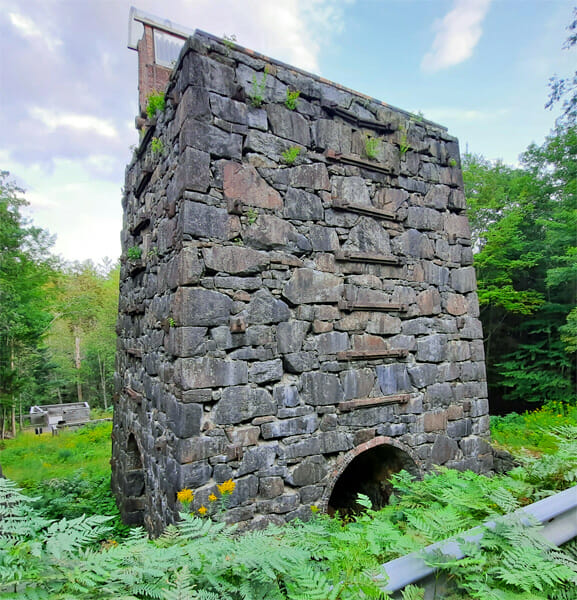
The stone furnace that one passes shortly before the Upper Works parking lot was the core of the iron-making operation. Construction of this furnace began in 1849 and was completed in 1854. At its peak, it produced 10-12 tons of iron per day.
Largely due to Henderson’s accomplishments the iron works reached its peak of productivity during the years from 1848 to 1853 with round-the-clock operation and production of 10-12 tons of iron per day.
But after his death there was no one who had his knowledge, energy, and problem-solving ability to lead the enterprise. A series of unfortunate circumstances eventually precipitated the demise of the iron works. In 1856 flooding destroyed the upper dam at the village of Adirondac as well as the dam and sawmill at the Lower Works (Also known as Tahawus, the Lower Works was about ten miles south of the village of Adirondac.) The financial panic of 1857 in the United States created economic instability for the company. Finally, the death of Archibald McIntyre in May 1858 left the operation leaderless with no one with the business acumen or desire to assume responsibility. The iron works ceased operation shortly after McIntyre’s death. “Work was dropped just as it was. …The workmen abandoned their homes, and Adirondac became, as it was for many years described, “The Deserted Village.”14
The village of Adirondac has had a succession of rebirths through the years, seeing new life as a series of sportsmen’s clubs, a game preserve, and a source for timber. Mining at Upper and Lower Works was also revived, but this time the ores being extracted were titanium, a component used in the production of white paint and enamels, as well as magnetite. Most recently the piles of tailings from the titanium mining are being crushed and sold as construction aggregate.
The next time you go to the Upper Works for a hike take a few minutes to read the interpretive panels about the history of the village of Adirondac and the iron works that line the gravel road from the new parking lot to the trailhead. Feel the incredible history of the area at your feet as you walk the trails along Henderson Lake or into the Flowed Lands and stop at the monument where Henderson met his unfortunate fate. Think for a moment that it all began with the discovery in 1826 by David Henderson and his scouting party of “the most extraordinary bed of Iron Ore.”15
* The Open Space Institute (OSI) acquired the nearly 10,000-acre Tahawus Tract in 2003 from NL Industries. In 2008 the OSI transferred most of the land to New York state for inclusion in the Adirondack Forest Preserve but maintained ownership of a 212-acre narrow corridor of land from Lake Jimmy to Henderson Lake in order to preserve the historic and environmental importance of the area. Working with the Town of Newcomb, and expending close to one millions dollars, the OSI has made a number of capital improvements to the area including enlarging and relocating the parking area for the Upper Works trailhead; stabilizing the iron furnace ruins and the MacNaughton Cottage; and creating trails around the iron works with interpretive panels that explain the site’s importance to Adirondack history.
Notes 1. Arthur H. Masten, The Story of Adirondac. (Syracuse University Press, Syracuse, NY 1968, First edition privately printed by Arthur H. Masten, 1923) 16-17. 2. Leonard A. Gereau, Tahawus Memories 1941-1963: The Story of a Unique Adirondack Hometown. (Hungry Bear Publishing, Saranac Lake, NY 2014) 8. 3. Masten, 18. 4. Masten,18-19. 5. Masten, 20-21. 6. Masten, 21. 7. Masten, 22. 8. Masten, 26. 9. Harold K. Hochschild, The MacIntyre Mine – From Failure to Fortune (Adirondack Museum of the Adirondack Historical Association, 1962, Second printing 1976) 3. 10. Masten, The Story of Adirondac, 59. 11. Masten, 100-101. 12. Masten, 101. 13. Masten, 103. 14. Masten, 143-144. 15. Masten, 18.
Grace Hudowalski, 46er #9, the first woman to record climbing the 46 High Peaks, and club’s long-time historian, often talked about “the healing woods.” She was referring to the memoir The Healing Woods (1952)* written by Martha Reben. Reben was a tuberculosis patient at the sanatorium in Saranac Lake, New York, during the 1930s. After three years of following the traditional treatment for the disease of bed rest and fresh air, and a number of unsuccessful surgeries, she decided to try something different. She hired a local guide to take her camping in the wilderness. For several years the pair spent spring through fall camping on the shore of Weller Pond, southwest of the Village of Saranac Lake. In her memoir Reben recounts her experiences in the wilderness, crediting the combination of constant fresh air, rest and relaxation, moderate exercise, and the restorative powers of the natural world for leading to her eventual cure from TB.
Like Martha Reben, Grace was a firm believer in the healing power of nature. As the club historian, Grace received innumerable letters from climbers describing personal issues that were having a negative impact on their lives – everything from battling cancer, or recovering from major surgery, to dealing with the stress and depression brought on by the death of a loved one, a divorce, or job loss. They all credited their time spent in the beauty and wonder of the great outdoors while climbing the 46 as giving them strength, healing, peace of mind, and the power to restore their health and positive attitude. Grace herself experienced the curative powers of the natural world as she struggled with her own health issues.
Many of us already know firsthand the sense of calmness and well-being that we experience when we are in the mountains. And we know that often that mental state is just as important, if not more so, than actually making it to the summit of a peak. In this extraordinary time of the COVID-19 pandemic that we are living through now, we are all searching for ways to cope with the myriad of uncertainties. We are all in need of some way to settle our fears and anxiety. Many of us will look to the strength and steadfastness of the healing woods to help us through the unknowns that surround our future.
If we are healthy, some of us will go on a hike – although the pandemic directive for “social distancing” and the hiking guideline of “don’t hike alone” seem to be mutually exclusive. The best we can do is to choose our hiking partner wisely. If you don’t want to, or are unable to go on a hike right now, there are other ways to make the human/nature connection. Walk or bike in a local park. Canoe on a lake as the ice allows. Sit on your porch, feel the breeze and listen to the songs of the birds. Just look up at the sky and watch the clouds moving above you. Or pull out your photos of previous hiking and camping trips and relive the moments. The gift of nature’s grace will find you.
Stay well and be safe.
If you do go hiking in the Adirondacks keep in mind that it is still winter in the High Peaks. A mid-March hike of Round Mountain presented a variety of trail conditions: a combination of ice, snow, and bare ground in the lower elevations; and quite a bit of snow at the higher elevations. So both microspikes and snowshoes are a must.
The spectacular views of the Dixes and Lower Range from the summit of Round Mountain were a welcome distraction from the news surrounding the COVID-19 pandemic, and a reminder of the importance of the human-nature connection.
*Unfortunately, Martha Reben’s book The Healing Woods is no longer in print.
The promise of a made-to-order hiking day with abundant sunshine, reasonable summer temperatures, and a light breeze convinced us to make our annual pilgrimage to the summit of Algonquin. What draws us to climb Algonquin at least once a year during the summer months is not to revel in the gorgeous views from the top – impressive as they may be – but rather to explore the unique flora that live on Algonquin’s open alpine summit. It’s those fragile plants with their delicate blooms and miniature size that elicit a sense of awe for the wonders of Mother Nature. Each time we visit Algonquin’s summit we see different plants in bloom and identify one or two that we hadn’t noticed before. It’s that thrill and excitement of discovery, like a child finding that wished-for gift under the tree on Christmas morning, that we yearn to experience.
The florae on the open Adirondack alpine peaks are arctic plants found elsewhere only on the tundra landscape of northern Canada, Alaska, and Greenland. Through a combination of environmental factors, geological history, and the quirks of nature, they manage to survive in the harsh environment of the high summits. Most of the plants are rare or endangered, and all of them are protected.
Alpine flowering and woody plants, dwarf shrubs, grasses and sedges, ferns and moss adorn the summit of Algonquin.
It’s particularly gratifying to see Algonquin’s summit covered in blankets of diverse plant communities, as that has not always been the case. During the 1960s and 1970s the Adirondack summits experienced a significant increase in hiker traffic. Unaware of the damage that walking on the alpine vegetation would cause, hikers were literally trampling the plants to death. Boots tore at the tundra, eventually eroding away the thin soils that supported the alpine plants. As hikers crisscrossed the alpine environment, taking their own route to the top, the summits were reduced to barren, grey, gravel paths, mostly devoid of plant life.
Most 46ers probably already know the story of how the barren mountaintops were transformed into the lush and thriving garden that we see on the alpine summits today. But it’s a success story that deserves to be repeated.
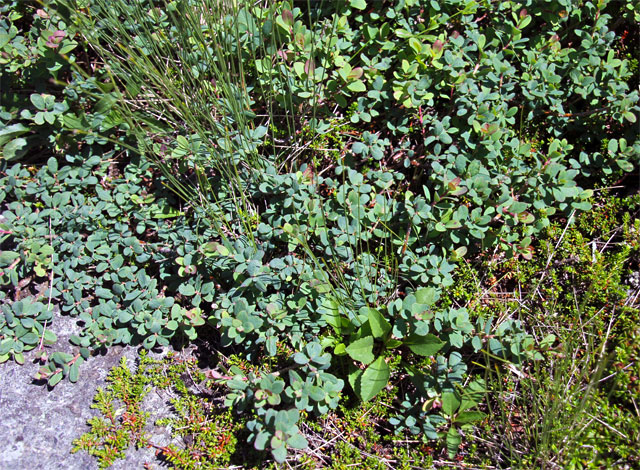
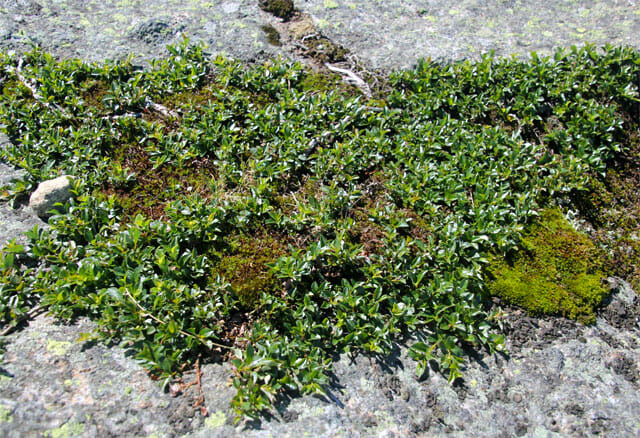
Bog bilberry: This alpine shrub is a relative of alpine blueberries. The leaves turn purple in the fall. Tundra dwarf birch: This is a low shrub that grows in dense thickets that rarely grows higher than two feet. It is an endangered species in New York. Bearberry willow: Believe it or not, this tiny creeping plant is a full-size tree! Note the small woody roots and trunk.
Dr. Edwin H. Ketchledge (46er #507) had been studying the degradation of the alpine environment of the High Peaks over the course of his 30 year career as a professor of ecology at the State University of New York College of Environmental Science and Forestry. His research delineated general trail erosion and more specifically the deterioration of summit vegetation. With support from the United States Forest Service, other ecologists, as well as hiking and conservation organizations in the Adirondacks, he developed a restoration program for the alpine summits. The plan included shoring up the eroded sides of the trails above treeline and then planting grass seed in the eroded areas to provide a seedbed for the native plants to grow. For more than twenty years hundreds of volunteers, many of them 46ers, carried the raw materials to the open summits for the restoration project — small rocks to stabilize the eroded trail sides, and five pound packets of lime (to counteract the acidity of the mountain soil), grass seed, and fertilizer to plant among the bare gravel areas.
Crowberry: With small evergreen-like leaves, Crowberry forms mats on the summit rocks. It is also found on rocky lower summits. Meadowsweet: This bush is common in the lowlands and is one of the larger alpine shrubs.
Over the course of several decades the grass grew. Mosses appeared and formed seedbeds for the pioneer plants (hardy species that are the first to appear in barren environments that have been damaged by natural or manmade causes) to take hold. The native plant communities slowly returned, and the non-native grasses died out. Today, hikers who climb to the top of the open alpine summits can attest to the remarkable success of Ketchledge’s experiment.
Cotton sedge: Also called “cotton grass,” this sedge is found in both lower elevations and on the edges of alpine bogs.
To protect the restoration work and prevent hikers from re-damaging the alpine plants, a number of groups including the Adirondack Nature Conservancy, Adirondack Mountain Club, New York State Department of Environmental Conservation, 46ers, and others joined forces to establish and provide support for the Summit Stewardship Program. Since its inception in 1989 the program has placed trained educators on the summits of the peaks with alpine vegetation to conduct plant inventories and to educate hikers on how to help protect the rare and fragile natural wonders.
Heart-leaved paper birch: Named for the shape of its leaves, this miniature tree with reddish bark is found in the krummholz and alpine zones in northern forests. Boott’s rattlesnakeroot: This is a globally rare plant that grows only on New York and New England summits. The plant was hiding among the grasses on Algonquin’s summit. The close-ups of the plant’s leaves and flower buds provide more detailed looks. Mountain sandwort: This pioneer plant, which is a hardy species that is the first to colonize barren environments that have been disrupted, such as by fire or erosion, grows in the krummholz and alpine zones.
So, the next time you are on one of the alpine summits in the Adirondacks consider it a privilege to be hiking among living plants that only grow in a few places on this earth. If you encounter a Summit Steward ask him or her to identify some of the plants for you. And remember to do your part to protect the delicate, fragile alpine vegetation:
Stay on the trails; follow the trail markers and paint blazes and rock cairns above treeline.